
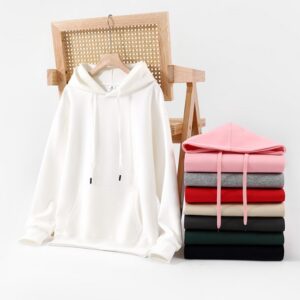
A hoodie RFQ should state whether the requested version includes a hood drawcord, then ask the supplier to confirm the exact offered configuration. Identify the garment model, cord appearance, visible exit arrangement and end treatment relevant to your selection. Obtain separate confirmation for any alternative. A catalogue picture with visible cords starts the discussion but does not establish every option available for the quoted hoodie.
Identify the pictured hoodie and the proposed supply version
Baohui’s homepage has a Hoodie category illustrated by a hanging garment and a folded stack. Cords are visible in the photograph. That makes the image useful for identifying an enquiry about this appearance, while the exact model and offered options still need a supplier response. Ask which current garment corresponds to the reference and whether the photographed cord arrangement is part of that version.
Keep the category link and the selected picture with the enquiry. If you are interested in an alternative without a cord, ask whether the supplier offers that configuration before including it in a comparison. Treat the alternative as a request, rather than an option confirmed by the website. Each accepted proposal should have a model or version reference that purchasing can carry into the sample and quotation records.
State what the quoted configuration must include
Start with the inclusion question: is the hood drawcord supplied with the garment being quoted? Then describe the appearance details that matter to the buyer. These may include a flat-looking or round-looking profile, a colour relationship to the garment and the visible cord-end treatment. Use the supplier’s response to confirm the offered construction and material instead of deriving those properties from a small category photograph.
Ask the supplier to distinguish the base version from any proposed change. A general reply that customization is possible does not identify which configuration is included in the actual offer. The buyer needs a specific response showing the version, the requested alteration and any commercial conditions that the supplier proposes. Price, minimum quantities and arrangements remain matters for that offer, without assumptions from the catalogue.
Configuration field | Supplier confirmation | Reference to keep
Cord inclusion | Supplied, omitted or still to be agreed | Exact offered garment version
Visible profile | Description of the proposed cord | Sample or clear close view
Colour relationship | Matching, contrasting or another agreed reference | Selected garment and cord references
Exit arrangement | Which visible arrangement the offered version uses | Front hood-area view
End appearance | Description of the proposed end treatment | Close view and supplier statement
Requested change | Whether it is included in the specific quotation | Revised offer and sample reference
Request views that connect the cord to the garment
Ask for a front hood-area view that shows the cord in relation to the garment. Add a close view of the exit area or cord end when that detail is part of the decision. A detached cord photograph may clarify its appearance, but it should be linked to the supplier’s proposed garment version. Keep the whole garment reference nearby so that a detail from another model is not accepted accidentally.
If a dimension is needed, ask the supplier to explain the measured feature and method. An exposed length, a total component length and a distance measured in a particular arrangement are different references. Record which one the supplier provides, together with the garment condition and unit. Agree any required tolerance separately; avoid filling in a dimension merely by estimating from the catalogue picture.
Compare like configurations before evaluating a quotation
Place the requested version and the supplier’s offered version side by side. Mark whether the drawcord question has been answered and list any proposed substitution. A quote for a different cord arrangement may still be worth considering, but it should be presented as a different proposal. Keeping that distinction clear prevents a purchasing decision from resting on an assumed match.
When comparing several offers, use the same requested configuration as the starting point. Ask each supplier to identify departures from it. Keep the visual description separate from unverified material or performance assumptions. A similar-looking end treatment, for example, is not enough to confirm its composition, durability or suitability for a particular requirement. Obtain information relevant to those requirements if they form part of the buyer’s decision.
Give the sample approval a precise scope
A sample request should identify the garment version and the agreed drawcord proposal. Ask whether the physical sample will show that exact combination or an illustrative substitute. If it is a substitute, record the difference and the questions it leaves open. This gives the buyer a useful basis for evaluating what was actually provided instead of treating every sample as the final proposed supply version.
When accepting a sample appearance, name the approved garment and the cord details that were reviewed. List unresolved matters beside that acceptance. If the buyer needs supporting material information or other evidence, keep it as a separate requirement with a clear supplier response. A concise appearance approval can be useful without implying that every possible product characteristic has been established.
• Obtain the current garment model linked to the selected category reference.
• State whether the enquiry requests a cord and ask which version is offered.
• Connect close views and any dimensions to the same proposed garment configuration.
• Keep substitutes and unanswered questions explicit in the sample approval.
Record later changes without losing the accepted option
If the supplier proposes changing the cord colour, profile, exit appearance or end treatment, ask it to identify the affected detail against the accepted reference. Retain the previous version while the buyer considers the proposal. The order record should show which option is current and which was superseded, rather than relying on the latest photograph in a message thread.
For a repeat enquiry, send the accepted configuration and ask the supplier to confirm the version currently offered. The folded colours in a category photo do not establish current stock or prove that the same cord arrangement applies to every colourway. A fresh, specific response lets the buyer preserve the intended appearance while obtaining the supplier’s actual offer for the new order.
Frequently asked questions
Does a hoodie photograph confirm that the cord is included?
It shows a catalogue appearance. Ask the supplier to state whether the cord belongs to the exact model and version in the quotation.
Can the buyer request a version without a drawcord?
The buyer can ask for that alternative. The supplier must confirm whether it is offered and identify the corresponding garment version and quotation.
What should a cord-end close-up confirm?
It can support an appearance decision for an identified sample. Ask the supplier to describe the proposed end treatment and provide separate material or other supporting information where required.
Product and contact references
Catalogue reference: confirm matching item: https://bhunderwear.com/products/?product_filter=%e5%8d%ab%e8%a1%a3
Related catalogue reference: https://bhunderwear.com/
Contact Baohui Apparel: https://bhunderwear.com/contact/
Baohui Apparel blog: https://bhunderwear.com/blog/