
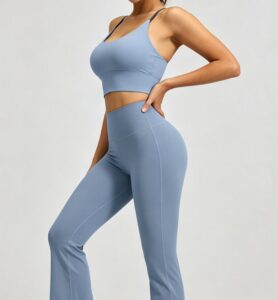
For a yoga wear sample enquiry, identify the selected bottom garment and request front, back and inside waistband views of that same version. Ask the supplier to define the waist measurement point, garment condition and unit used in its size information. A worn photograph helps identify an appearance preference; a useful sample record connects that preference to a specific garment and a repeatable measurement description.
Select a garment before discussing the waistband
Baohui’s homepage includes a Yoga Wear category with a photograph of a model wearing a coordinated outfit. It gives a buyer a visual starting point for an enquiry about the lower garment. The category reference does not provide an individual item specification. Ask the supplier to identify the current garment model and variant that correspond to the appearance you have selected before requesting a sample.
Send the category link and identify the lower garment in the picture. Describe the visible feature that interests you, such as the front waist appearance, using neutral language. Let the supplier confirm the construction and offered options. Product information from a separate thermal underwear page should stay attached to that item rather than being carried over to a yoga wear enquiry.
Give the supplier a view list that answers specific questions
A front view can show the visible outline of the waist area. A back view can clarify the rear arrangement, while an inside view may reveal details hidden when the garment is worn. Ask which features the supplier can show for the exact sample under discussion. If your decision concerns a particular seam, opening or adjustment feature, name the question so that a useful close view can be supplied.
Keep these views connected to one identified sample. A collection of attractive photographs from several garments is difficult to use as a construction reference. Ask the supplier to identify any illustrative image or substituted sample. The buyer can then distinguish details that have been shown for the proposed garment from details that remain to be confirmed.
Requested reference | Question it helps answer | Additional confirmation
Front waist view | What is the visible front outline? | Which model and sample version are shown?
Back waist view | How is the rear waist area presented? | Does it belong to the same sample?
Inside waist view | Which relevant internal details are visible? | What construction does the supplier declare?
Named measurement view | Where is the stated dimension taken? | What method, condition and unit apply?
Whole lower garment | Which item carries the detail being reviewed? | Which offered variant matches the enquiry?
Define the measurement condition before comparing numbers
Ask the supplier where the waist measurement begins and ends, whether the garment is laid flat, and what condition applies to the measurement. If more than one condition is reported, keep each value separately labelled. A dimension is easier to compare when the measurement description travels with it, rather than appearing as an isolated number in a size chart.
The buyer should also ask whether the chart refers to the garment or to an intended wearer measurement. These are different references, and the supplier should explain the basis used for the selected model. Avoid creating an order value by doubling, stretching or converting a supplied number without an agreed method. Where a tolerance is needed, request the supplier’s proposal and agree its application before using it for acceptance.
Separate a visual preference from a fit or performance requirement
A buyer can select a clean-looking front, a particular waist height appearance or an arrangement of visible details as a design preference. Record what that selection covers. A pose in a category photograph does not establish compression, recovery, moisture management or comfort for an offered garment. Those requirements need their own defined scope and supporting supplier information.
If waist height matters to your selection, ask the supplier to identify its measurement points and show them on the proposed sample. If an adjustment feature is required, ask which option is actually offered and how it is represented in the sample reference. Keep the enquiry specific to the purchasing decision instead of assigning a construction or performance term merely because the photograph suggests it.
Build a sample response that purchasing can compare
Ask the supplier to return the garment reference, the requested views and its measurement description together. List unanswered questions beside the response. This lets a buyer compare proposals using consistent subjects: the selected model, the sample shown and the meaning of each stated measurement. It also makes clear when one supplier has provided a complete response and another has supplied only an appearance image.
When requesting a physical sample, identify which version should be supplied and what information should accompany it. Obtain the supplier’s actual sample arrangements rather than assuming availability, charges or timing. The buyer can then conduct its intended evaluation with an identified garment and a documented reference, while keeping any remaining technical or commercial question visible.
• Obtain the current model and variant corresponding to the selected lower garment.
• Request the front, back and inside views needed for the buyer’s decision.
• Record the waist measurement points, garment condition and units together.
• Identify illustrative photos, substitutions and unanswered construction questions.
Keep later revisions attached to the same reference record
If the supplier proposes a revised waist area, ask it to identify the affected detail and provide the relevant updated view. Preserve the earlier reference until the buyer decides which version applies. A new overall photograph may be useful, but the changed area should still be clear enough to support the actual decision.
For an order or repeat enquiry, refer to the accepted garment version and the agreed measurement description. Ask the supplier to confirm whether either has changed. This avoids carrying a number forward after its measurement basis has changed, or treating a similar-looking category picture as proof that the previously discussed sample is still the offered product.
Frequently asked questions
Can a worn photograph establish the waistband construction?
It shows an appearance under the photographed conditions. Ask the supplier for the relevant inside view and its construction description for the identified sample.
What should accompany a waist measurement?
Record the garment reference, measurement points, garment condition and unit. Ask whether the value describes the garment or an intended wearer measurement.
Does a high-looking waist prove a shaping effect?
No. Treat the visible appearance as a design reference. Any shaping, compression or other performance requirement needs separate information and an agreed evaluation scope.
Product and contact references
Catalogue reference: confirm matching item: https://bhunderwear.com/products/?product_filter=%e7%91%9c%e4%bc%bd%e6%9c%8d
Related catalogue reference: https://bhunderwear.com/
Contact Baohui Apparel: https://bhunderwear.com/contact/
Baohui Apparel blog: https://bhunderwear.com/blog/