
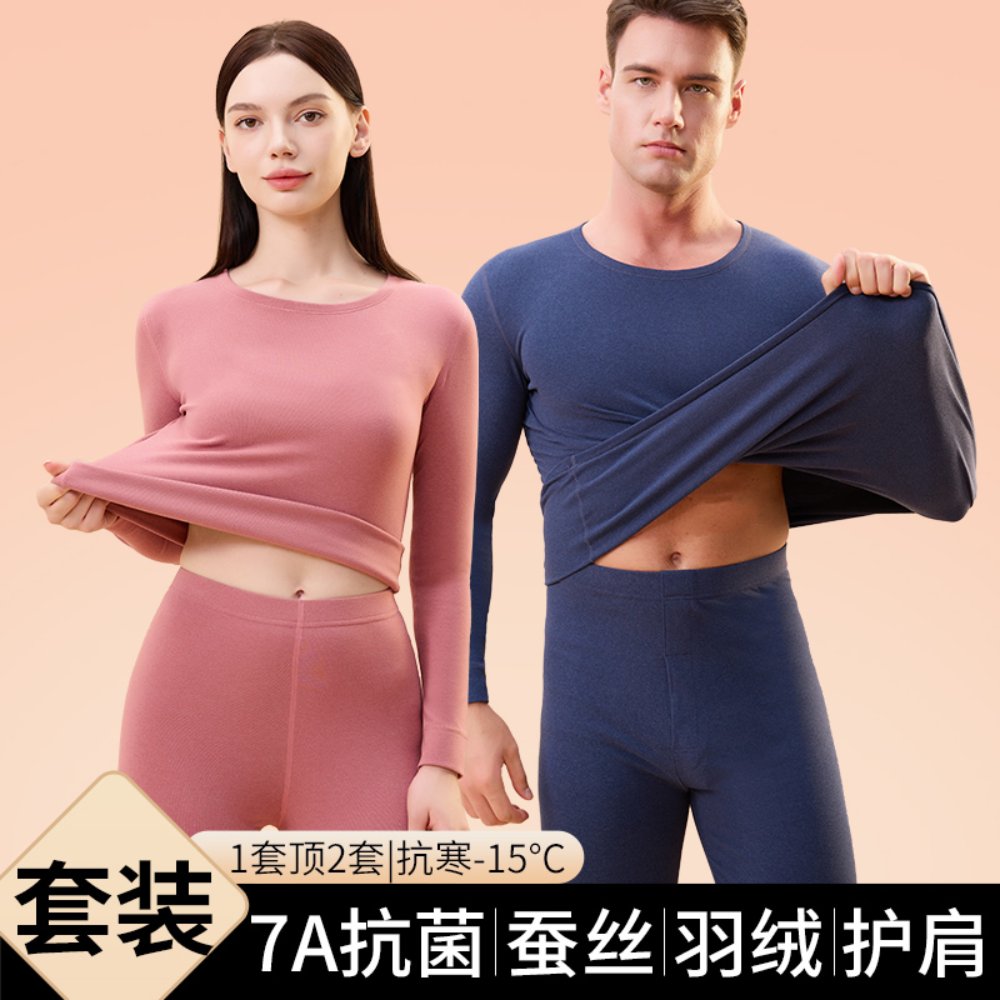
A thermal set RFQ should list every garment that the quoted set includes, then connect those pieces to the supplier’s model, variant and size references. Ask whether the top and bottom are supplied as a fixed pair or can be ordered separately. Keep quantities in sets distinct from quantities in individual garments. A photograph showing a complete outfit does not, by itself, confirm the commercial contents of a quoted set.
Use the catalogue item as an enquiry reference
Baohui’s catalogue lists a 260g Ribbed Thermal Underwear Set for Men and Women. The product page and its photograph give a buyer a specific starting point for a sourcing enquiry. The title is a catalogue description, rather than an agreed measurement definition or proof of the garments included in a quotation. Ask the supplier to identify the current model and the version it proposes to supply against that reference.
The photograph contains more than one worn outfit. If your enquiry concerns only one option, identify it directly and obtain the supplier’s matching variant reference. Do not let the number of people or garments in a styled photograph become the assumed number of sets in an order unit. The commercial definition should come from an explicit supplier response and the buyer’s accepted component list.
Make a component list before comparing set prices
List the top and bottom as separate components within the proposed set. Ask the supplier to confirm the garment descriptions, variant references and whether any pictured accessories are included. This makes it possible to compare offers on the same basis. A lower set quotation is difficult to interpret if one response includes both garments while another concerns only a single component.
If the supplier uses one code for the complete set, ask how the individual garments are identified within that code. The buyer does not need to invent a new product system; it needs a clear connection between the quoted unit and what will be supplied. Keep the supplier’s original references alongside the buyer’s descriptions so that order entry and later packing discussions use the same identities.
RFQ field | Confirmation to request | Ambiguity it removes
Quoted unit | Whether the offer is for a complete set or one garment | A set price compared with a piece price
Top component | Current model and selected variant reference | Which upper garment is included
Bottom component | Current model and selected variant reference | Which lower garment is included
Pairing rule | Fixed combination or separately agreed selection | Unapproved mixing of components
Pictured extras | Included or excluded, item by item | Styling items treated as supplied contents
Order quantity | Number and explicit unit | Sets confused with individual garments
Confirm how the top and bottom are paired
A buyer may want the top and bottom to share a size label, or may need a separately agreed combination. Ask which pairing the supplier actually offers for the selected model. Do not assume that a request for mixed component sizes is available simply because the garments are photographed separately. The supplier should state whether the proposal is a fixed set, a configurable combination or two independent garment lines.
Record colour pairing in the same way. If a catalogue photo shows a coordinated outfit, ask whether that exact combination is the proposed supply version. Matching appearance does not establish identical fabric composition or an interchangeable colour standard between components. Where either garment changes, ask whether the complete set reference also changes and which previous approval the proposal replaces.
Keep material and weight questions attached to each component
The thermal-set page contains a supplier material description and a weight-related term in its title. If these details matter to your purchase, request a current specification that identifies what each statement applies to. Ask whether a stated composition covers the top, the bottom or only a particular fabric area. For a weight-related figure, request its unit, measurement basis and the product version covered before treating it as an order requirement.
The catalogue image also contains promotional statements. Those statements do not independently establish temperature suitability, antibacterial performance or the materials in a finished order. Keep any such requirement separate from the component-count decision and request supporting information relevant to the exact offered item. Confirming that a set contains two identified garments is an inclusion decision; it is not a performance acceptance.
Reconcile set quantities with the proposed packing record
State the requested number of sets using a written unit, then ask the supplier how that translates into individual garment quantities. Where separate tops or bottoms are also being requested, give them distinct order lines. A combined total without a unit can obscure whether additional garments are included or whether a complete set has been counted more than once.
Discuss packaging after the supplied contents are clear. Ask how the supplier proposes to keep each accepted combination identifiable in its packing record. If components are packed separately, request a way to reconcile them with the agreed set allocation. If they are packed together, confirm which component references belong in each package. Obtain the actual packing proposal instead of assuming that the catalogue presentation shows the delivery arrangement.
• Name the selected catalogue item and obtain its current supplier model reference.
• List the included top and bottom, with their variant and size references.
• Agree whether the component pairing is fixed or separately selectable.
• Write quantities in sets and identify any additional individual garments separately.
Carry one accepted component list into the sample request
When requesting a sample, refer to the accepted component list and ask which pieces the sample package will contain. Identify any substitute or illustrative garment before it is dispatched. A sample top alone may help answer a specific question, but it should not be recorded as a complete physical set approval when the bottom has not been supplied for the buyer’s evaluation.
Keep the supplier’s final response with the component list used for quotation. If the proposal changes later, identify the affected garment and the revised pairing rather than replacing a broad description without explanation. This gives purchasing a clear basis for comparing the sample, quotation and intended order while leaving price, minimum quantities, availability and delivery arrangements to the supplier’s actual offer.
Frequently asked questions
Does a thermal set title confirm the number of garments supplied?
It identifies a catalogue item, but the quoted contents should still be listed explicitly. Ask whether the offer includes the top, bottom and any other pictured item before comparing quotations.
Can the top and bottom have different size labels?
Ask the supplier whether that combination is offered for the selected model. Treat it as a proposed pairing that needs confirmation, rather than a capability established by a photograph.
Should image claims be copied into the purchase specification?
Only requirements that the buyer has defined and the supplier has explicitly supported should enter the agreed specification. A promotional image does not independently verify materials, temperature suitability or other performance.
Product and contact references
Catalogue reference: confirm matching item: https://bhunderwear.com/product/260g-ribbed-thermal-underwear-set-for-men-and-women/
Related catalogue reference: https://bhunderwear.com/
Contact Baohui Apparel: https://bhunderwear.com/contact/
Baohui Apparel blog: https://bhunderwear.com/blog/